
Establishing Clear Roles and Responsibilities in the Utility Sector
Utilities and infrastructure operators have teams and departments that must coordinate and collaborate to achieve the company’s mission and objectives efficiently. Achieving that goal is essential to reaching operational excellence.
A challenge in achieving operational excellence in utilities is that there isn’t a silver bullet, model, tool, or practice to deliver it. Like personal health and welfare, operational excellence in organizations requires many elements that, in combination, create the conditions for success. The range of factors contributing to operational excellence in utilities includes effective leadership, a viable business strategy, business processes, technology, employee engagement, communication, and the ability to execute all functional tasks required to complete the company’s work. That said, having people in the right roles, with the capability and role clarity to perform them, is foundational.
At the Engine Room, we frequently support utilities and infrastructure operators that have invested heavily in recruiting capable, qualified, and well-intentioned people, only to find that individuals hold different beliefs about what their roles should involve. In many cases, varying strengths and weaknesses further shape how work is approached and executed, leading to inconsistent outcomes.

Achieving operational excellence in these conditions is similar to building a winning Olympic relay team. Each individual must execute their role at a high level, while seamless coordination is required during critical handoffs. Operational excellence depends not only on strong individual performance, but also on effective interactions between roles and teams. In our view, both dimensions must be developed in parallel. To address this, the Engine Room has developed an improvement approach that works simultaneously across two dimensions: horizontally, to clarify functional roles within a business process, and vertically, to define leadership roles, accountabilities, and decision-making rights.
Horizontal Role Clarification
Horizontal role clarification leverages tools such as process mapping and models such as RACI to produce documented descriptions of how business processes work and the responsibilities of different participants within them. It is the more common form of role clarification. In utility organizations, horizontal role clarification is a powerful enabler of operational excellence across forecasting, planning and scheduling, budgeting, regulatory relations, and other end-to-end business processes that span multiple teams. These processes typically require coordinated inputs, disciplined analysis, and clear decision-making before action can be taken.
In applying horizontal role-clarification tools, The Engine Room has found that while the RACI model is widely recognized, the RAPID model more effectively addresses its known limitations including the frequent confusion between “responsible” and “accountable.” As a result, we use the RAPID framework to identify the different roles and contributions across a business process as follows:
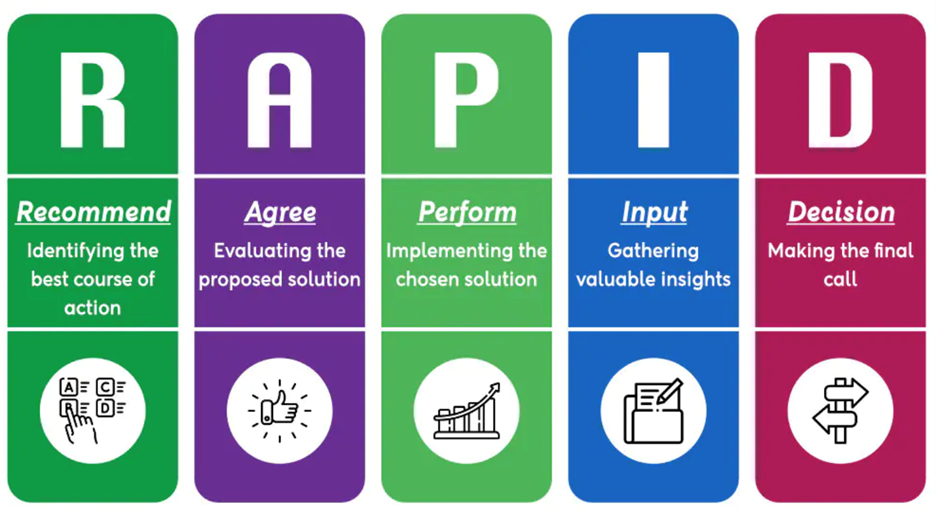
To clarify roles and responsibilities across complex business processes such as planning and scheduling fieldwork in an electric utility, the RAPID model is a highly effective tool. It enables the development of clear process descriptions that help participants (such as planners and schedulers) to understand their roles, while also providing broader organizational visibility into how the process functions form end to end.
What horizontal role clarification does not address, however, is the vertical leadership structure surrounding the process. Business process participants report to managers, who in turn report to more senior leaders. While these leaders may not be directly involved in day-to-day tactical activities, they retain critical supervisory, leadership, and governance responsibilities.
Vertical Role Clarification
Vertical role clarifications address how responsibilities should change at different levels of the organizational chart. Achieving operational excellence recognises that all levels of the organisation chart play a role, and it’s generally understood that supervisors and the CEO have different responsibilities. However, it is still common to see people with leadership or supervisory responsibilities operating at one or even two levels below their position title. At the same time, other leaders may feel entitled to, or even obliged to, weigh in on or interfere in matters that are not their responsibility.

These misalignments can manifest as managers who micromanage their subordinates, directors who engage with front-line employees in ways that undermine supervisors and managers, executives who concern themselves with operating details that are seen as getting ‘lost in the weeds’, or managers who think they are entitled to tell peo