How Better Planning and Scheduling Can Help Utilities Complete More Work With the Same Resources
Electric utilities are facing a difficult operating equation.
They are being asked to modernize the grid, improve reliability, respond to increasing customer expectations and deliver growing capital and maintenance programs. At the same time, affordability and rate pressure are putting greater scrutiny on costs. In simple terms, many utilities need to accomplish more work without a corresponding increase in people or budgets.
Technology will certainly play a role. Utilities continue to invest heavily in ERP platforms, advanced metering, smart grid technology, automation and increasingly artificial intelligence. But there is a more fundamental productivity opportunity that can sometimes receive less attention: how effectively work moves from an identified need to completed field execution.
That is the role of IPSECA:
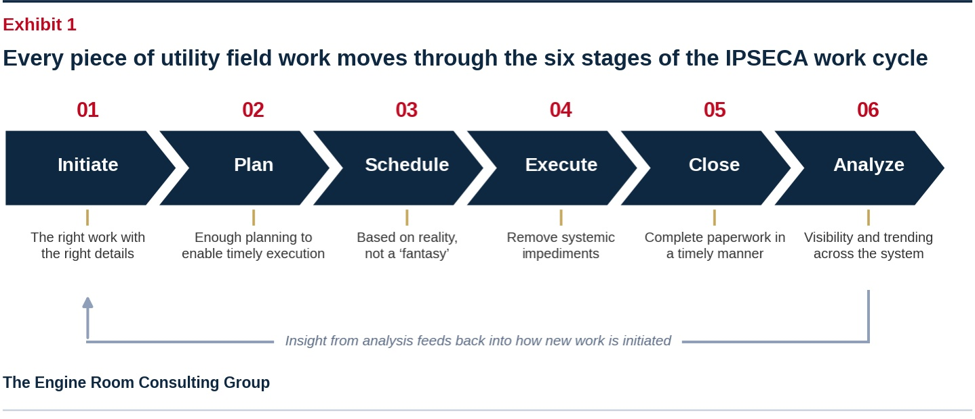
Every piece of utility field work moves through some version of this cycle. Whether the work involves a customer connection, preventative maintenance, corrective maintenance, trouble response or a major capital project, somebody must identify the work, determine what is required, prepare it for execution, assign resources, complete it and close it out.
The productivity of the field workforce is therefore not simply a function of what happens in the field. It is the cumulative result of the entire work cycle.
The Field Crew Is Not Always the Productivity Problem
When we discuss utility productivity, attention naturally gravitates toward field execution. How much time are crews spending on tools? How many jobs are they completing? How much windshield time is occurring? How quickly can they move between assignments? Those are legitimate questions, but they can also lead organizations to focus on the latter stages of a much larger process. A crew cannot productively execute work that has not been properly initiated, planned or scheduled.
If sufficient executable work is not moving through the pipeline, crews eventually run short of productive assignments. If materials are missing, permits are incomplete, or job information is inaccurate, crews lose time resolving issues. If work is poorly bundled, crews may travel repeatedly to the same location. If schedules cannot accommodate normal field variability, supervisors and schedulers spend their days rearranging work.
Exhibit 2
Field productivity issues are often symptoms of breakdowns earlier in the work cycle
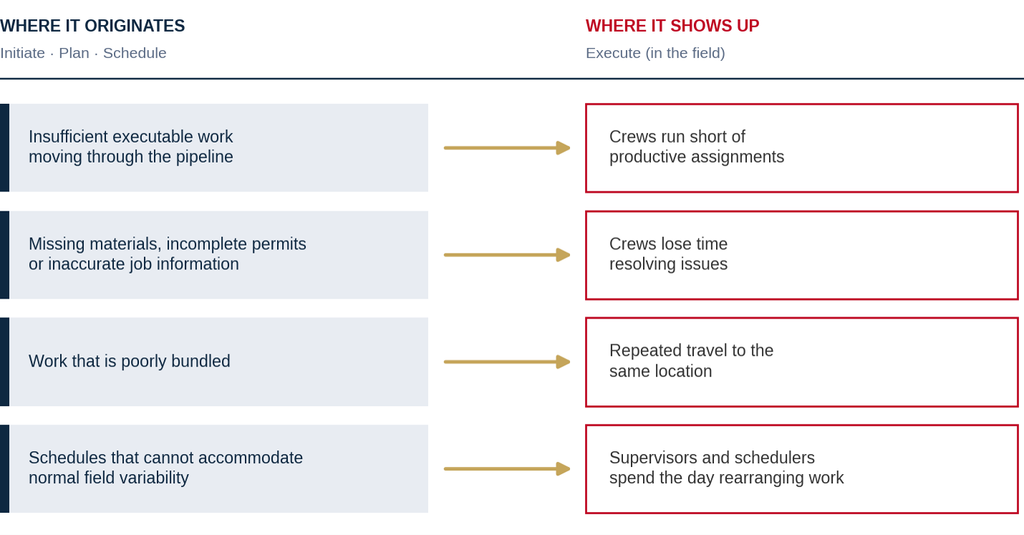
What appears to be a field productivity problem can therefore originate much earlier in the process. The more useful question is not simply:
“How do we make our crews more productive?”
It is:
“Where is productivity being lost across the entire IPSECA cycle?”

1. Initiate: Get the Right Work Into the Pipeline
Utility work does not enter the organization in one consistent way.
Grid expansion and modernization projects can have long development cycles. Preventative maintenance operates on an intermediate cycle. Customer connections can move relatively quickly. Corrective maintenance and trouble work may require an immediate response.
Exhibit 3
Utility work enters the organization on fundamentally different cycles
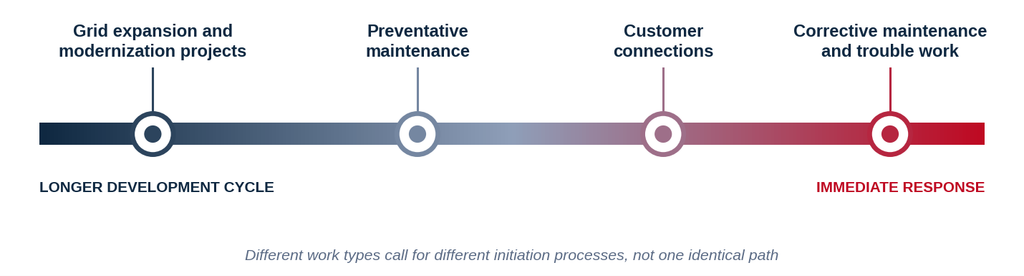
Trying to force these fundamentally different work types through identical processes can create unnecessary complexity. Good initiation requires clarity about what actually needs to be accomplished and what constitutes the appropriate dispatchable unit of work. For customer work, that can mean defining the customer’s actual requirement before sending it deeper into design and planning. For maintenance, it can mean determining whether multiple notifications associated with the same asset or location should become one coordinated job rather than several independent pieces of work.
The objective is not simply to create work orders. It is to introduce well-defined work into the system in a form that can move efficiently through the remaining IPSECA stages.

2. Plan: Make Crew Work Immediately Executable
Planning is one of the most significant opportunities for improving utility productivity. A good work order should provide the field with the information necessary to execute the work without having to recreate the plan after arriving at the job site. That includes getting several fundamentals right:
- appropriately sizing the work;
- completing required design, environmental, easement and grid-impact activities;
- accurately estimating requirements, ensuring parts and materials are available; and
- incorporating the practical field information crews need to execute safely and efficiently.
But there is another planning issue that deserves particular attention: how work is bundled.
Consider a location where a utility needs to change a pole and crossarm, repair a switch and sample a transformer. From a productivity perspective, there ma