How Canadian Utilities Can Convert Unprecedented Investment into Completed Field Work While Protecting Safety, Affordability, and Reliability
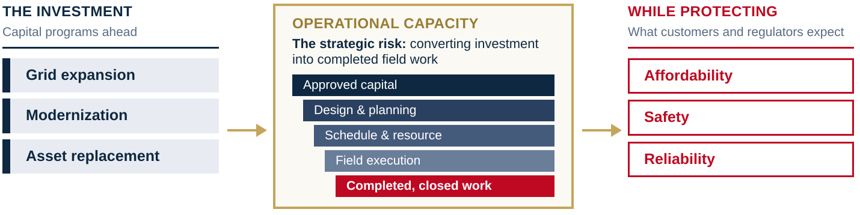
Canadian utilities are entering a period of investment without modern precedent. Grid expansion, modernization and asset replacement programs are growing in parallel, driven by electrification, new customer connections, aging infrastructure and the need to strengthen systems against more severe weather. Much of the public discussion focuses on what this will cost and how it will be funded. Those questions matter. But for many utilities, the strategic risk is increasingly whether the operating organization can efficiently convert those investments into completed field work.
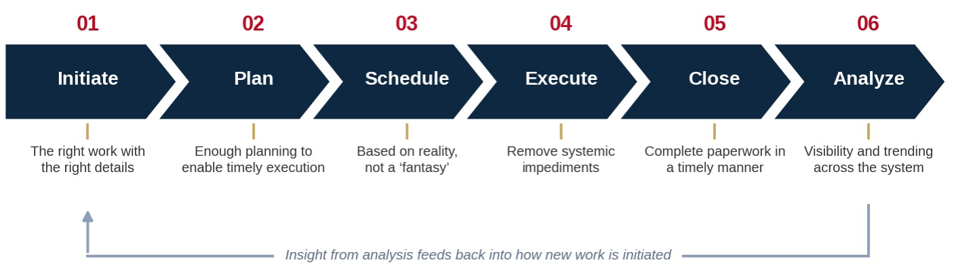
Every dollar of approved capital eventually becomes a design, a work order, a schedule, a crew assignment and a closed job. If the organization that performs those steps cannot keep pace, the result is deferred projects, rising unit costs, missed customer commitments and greater pressure on the people doing the work. That makes the challenge larger than productivity improvement. The task is to build the operational capacity utilities need to deliver unprecedented levels of work while protecting safety, affordability and reliability. That capacity does not come primarily from new platforms. It comes from being exceptionally good at delivering the core work, safely and efficiently, every day. Two levers matter most: discipline in the IPSECA work process, and Operational Leadership at every level of the organization.
Exhibit 1. The strategic risk lies in converting investment into completed field work
From Funding the Work to Delivering It
Capital projects offer a visible response to growing demands. New equipment adds capacity, and digital platforms promise better information and more coordinated decisions. Traditional cost-of-service regulation reinforces this: approved capital assets enter the rate base and earn a regulated return, while spending on people development and operating practices generally receives different treatment. The precise incentives vary by jurisdiction, but the distinction can make physical and technological investment easier to advance than improvements in organizational capability. In our experience, only 5 to 8 percent of major transformation budgets is allocated to people development.
As programs grow, that imbalance becomes more consequential. A utility can secure approval for a much larger program yet still lack the operational discipline and leadership capacity to optimize work initiation, planning, scheduling, execution and closing. The binding constraint shifts from the budget to the operating system that turns budget into completed work.
The constraint shows up in everyday events. Consider a crew arriving for a customer connection with an inaccurate design. The crew cannot complete the work. The utility must correct the design and schedule another visit, and the customer may need to reschedule an electrician. What appears internally as a planning error becomes a service failure and an additional demand on scarce field capacity. Multiplied across hundreds of crews and thousands of truck rolls, failures of this kind become a material limit on how much of the investment a utility can deliver. So long as trucks roll and employees are in the bucket, you’re still in the people business.
Process Discipline: Fixing the Work Cycle
One Canadian utility engaged The Engine Room to improve bottom-line field crew productivity and reduce OM&A costs across asset planning, engineering, design, planning, scheduling, and distribution crews. The goal was not new capital or new software. It was to improve the end-to-end effectiveness of the work the utility already did, following the IPSECA work cycle.
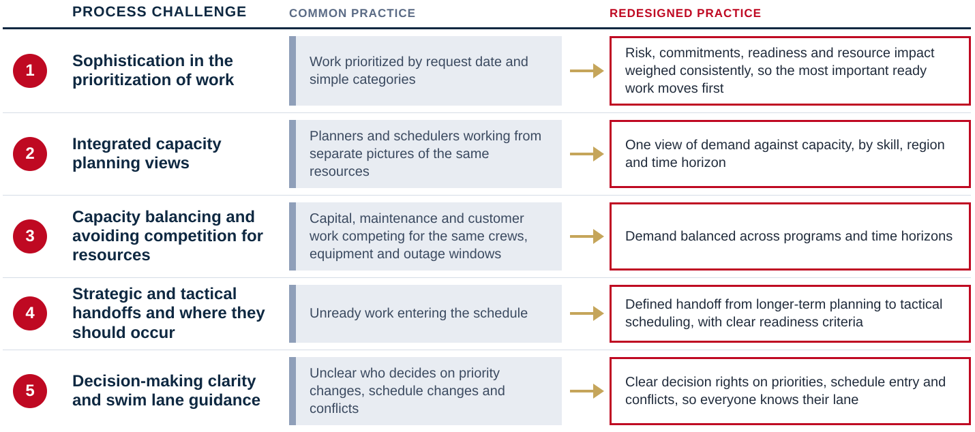
The diagnostic found that the greatest opportunities lay not within any single group but in the handoffs between them. As in many utilities, work was sometimes released before it was fully ready, bundles did not always make the best use of crew capacity, and schedules had limited flexibility as conditions changed. Each team worked hard to meet its own objectives, yet the full benefit of that effort did not always reach the field, where crews absorbed the impact through rescheduling and rework. To close those gaps, the utility redesigned its planning and scheduling practice around five process challenges we see across the industry:
Exhibit 3.
With the process redesigned, the utility implemented tiered measures so executives, senior managers, and frontline leaders all looked at the same picture. Executives tracked enterprise outcomes. Senior managers focused on the drivers they could control, such as backlog relative to capacity and unit cost. Frontline leaders monitored work order aging, crew loading and execution. Productivity became the responsibility of the full vertical slice of the organization and not just a frontlin