
Why understanding the ‘root causes’ of operational inefficiency may be one of the most important opportunities for utility leaders.
Canada’s electricity sector is entering a period of unprecedented investment and growth. Electrification, aging infrastructure, new customer connections, grid modernization and increasing resilience requirements are all contributing to rapidly expanding capital and maintenance work programs. The federal government’s 2027 electricity strategy projects that Canada’s electricity system capacity will need to roughly double by 2050.
For utilities, the challenge is no longer simply securing the capital required to build and maintain the grid. It is ensuring their organizations have the operational capability to turn those investments into completed work. Utilities can invest in additional resources, technology, and infrastructure, but if work is not effectively initiated, planned, prioritized, scheduled, and executed, those investments may not deliver their intended productivity or cost benefits.
Exhibit 1
Investment delivers results only when the work is executed effectively
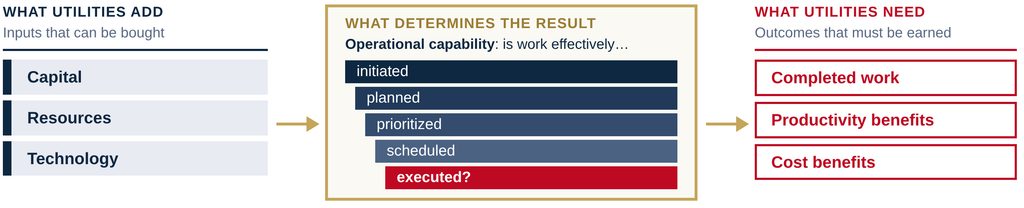
Increasing capital budgets does not automatically translate into increased work execution capacity. The question is whether utilities can complete significantly more work without a proportional increase in resources and operating costs.
The Real Productivity Problem May Not Be Where You Think
When productivity challenges emerge, the symptoms are often easy to recognize. Projects fall behind schedule. Field crews encounter delays. Work backlogs increase. Resources appear stretched. Costs rise, and capital delivery targets become harder to achieve.
But are these the actual problems, or simply the visible consequences of deeper organizational issues?
Consider a field crew that arrives at a job site only to discover that materials are unavailable, permits are incomplete, or the work package lacks critical information. The resulting productivity loss occurs in the field, but the root cause may exist several steps earlier.
Similarly, an organization may believe it has insufficient resources when the underlying problem is poor capacity planning, competing departmental priorities or ineffective coordination between work groups.
Exhibit 2
The symptoms of lost productivity are visible; their root causes often are not
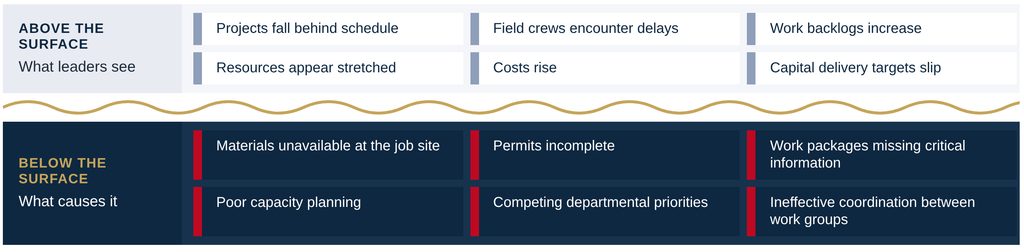
Treating the symptoms of poor productivity without understanding their root causes can lead utilities to invest more money and resources without materially improving performance. This is why a comprehensive operational diagnostic is so important.
Finding the Leaks in the Boat
A well-designed operational diagnostic goes beyond reviewing performance indicators, interviewing leadership and identifying obvious inefficiencies.
It examines how the organization actually functions: how work moves between departments, where decisions are made, how resources are allocated and where breakdowns occur across the end-to-end work cycle. Several critical questions deserve attention:
Exhibit 3
Six questions a comprehensive operational diagnostic should answer
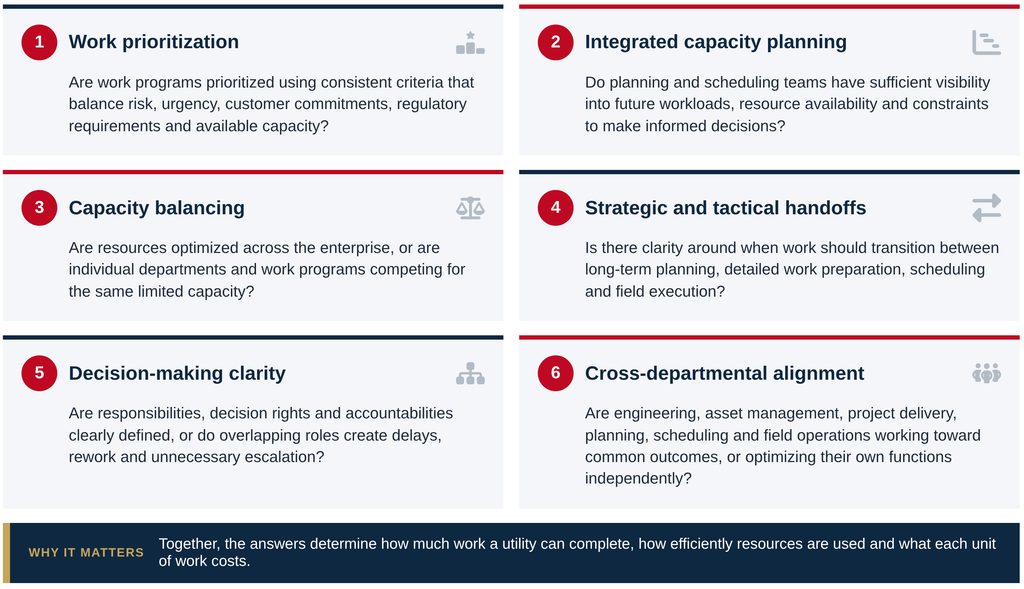
These are not simply administrative or organizational considerations. They directly influence how much work a utility can complete, how efficiently resources are utilized and how much each completed unit of work costs. Importantly, the root causes rarely exist within a single department.
From Operational Diagnosis to Measurable Improvement
Every utility work program moves through some variation of the same operating cycle: initiate, plan, schedule, execute, close and analyze (IPSECA). Productivity is gained or lost at every stage, but frequently the greatest opportunities exist at the handoffs between them.
Exhibit 4
Productivity is gained or lost at every stage, and most often at the handoffs

A diagnostic should therefore assess the entire operating cycle, distinguish symptoms from root causes and identify the specific changes that will deliver the greatest operational benefit.
Those changes may involve improved prioritization, integrated resource planning, clearer decision rights, better work-package quality, more flexible scheduling, stronger leadership accountability or improved visibility into the work pipeline.
The objective is not simply to produce another assessment or list of recommendations. It is to identify the root causes of lost productivity, implement practical solutions and build the organizational capability to sustain the improvements. The business case is compelling:
Exhibit 5
Improving execution capacity creates a chain of value for utilities and their customers

The Strategic Question for Utility Leaders
As Canada’s utilities prepare for unprecedented infrastructure investment, the ability to execute work efficiently will become an increasingly important strategic and operational advantage.
Additional funding, technology, an